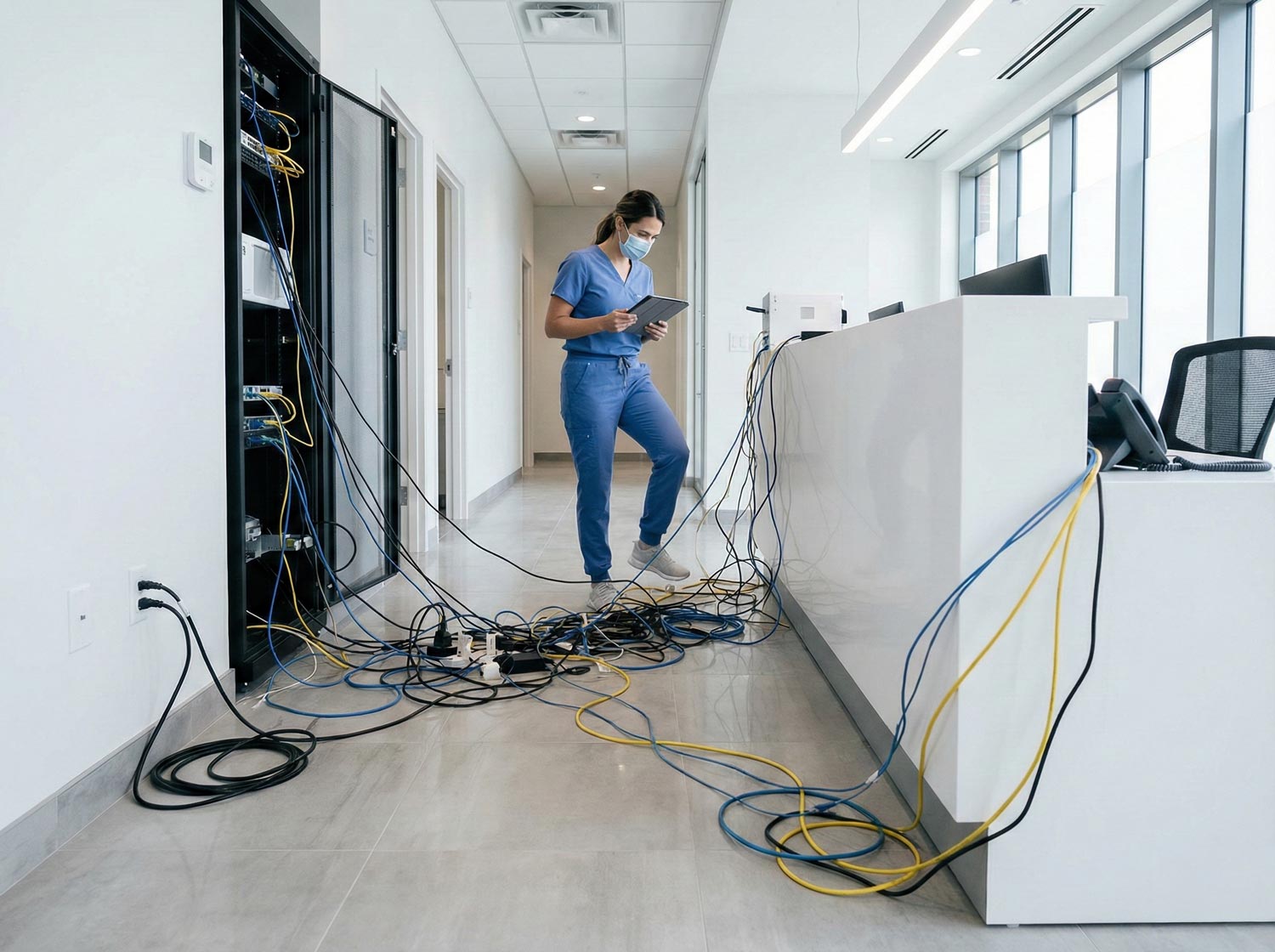
Best-of-Breed instead of Silo Frustration: How MVZs and Practices Tame Their Software Zoo with FHIR and Data Warehousing
Do you also have that one infamous Excel list in your MVZ or practice? The one that has to be manually updated at the end of each month so that management gets somewhat reliable figures? Or the modern online appointment tool that looks fantastic but unfortunately doesn't "know" what's actually in your specialists' calendars?
If you're nodding here, welcome to the reality of many healthcare providers.
In a growing Medical Care Center (MVZ) or a modern large practice, IT homogeneity is often an expensive illusion. Different specialties have completely different requirements: Gynecology needs different documentation workflows than orthopedics; radiology requires a powerful RIS/PACS, while general medicine relies on speed in master data management.
The logical consequence: You rely on "Best-of-Breed". You purchase the best software for each area. This is medically correct but often leads to a technical dead end: The silo landscape.
In this article, we show you how to tame this "software zoo" – not by replacing all systems, but through an intelligent integration layer with FHIR and a central Data Warehouse.
The Dilemma: Why Specialization Without Strategy Blinds
The IT stack of many practices and networks grows organically. You buy a tool here, take over a seat with existing software there. After a few years, IT managers face a patchwork:
- System A (PVS Radiology): Might still speak HL7 v2 or DICOM.
- System B (PVS General Medicine): Uses a proprietary GDT interface.
- Tool C (Patient Admission/iPad): Offers a modern REST API but can't access legacy data.
The consequences are fatal. Operationally, employees have to maintain data twice (error source No. 1). Strategically, management is flying blind because central reporting across all locations is hardly possible. Anyone who wants to know which location is profitable or where patient flows are stagnating has to laboriously export reports from three different systems and manually merge them.
The Problem vs. The Solution
To understand why classic interfaces (point-to-point) fail here, a look at the architecture helps.
Solution Part 1: FHIR as a "Universal Adapter"
To solve this chaos, we need a standard that is flexible enough for modern web apps but robust enough for complex medical data. This is where FHIR (Fast Healthcare Interoperability Resources) comes into play.
Forget the technical complexity for a moment. Strategically, FHIR is nothing more than a universal adapter.
Instead of your online calendar having to speak the language of "Medistar", "Tomedo", and "Turbomed" simultaneously, all systems agree on FHIR. A small "communication server" (or a so-called FHIR Facade) is placed in front of the old systems. It translates the cryptic data of the legacy systems into clean, standardized FHIR resources.
The result: For external applications, your IT landscape suddenly appears homogeneous. When an app asks: "Give me the patient list", it doesn't matter if there are three different databases underneath. FHIR returns a unified list.
Solution Part 2: One Architecture, Two Speeds
Now comes the crucial strategic step. Once your data is standardized via the FHIR layer, you have created a clean foundation. However, modern MVZs have two completely different requirements for this data.
This is often referred to as a "Two-Speed Architecture":
1. The "Fast Lane": Operational Apps (Real-Time)
In daily operations, speed is essential. A patient books an appointment via app, a doctor retrieves findings on the go.
- The Path: These applications communicate directly with the FHIR server.
- Why? They need real-time data (Is the appointment now available?) and must also be able to write data back (book an appointment).
- The Advantage: You can connect new tools (e.g., a check-in app for the iPad) at any time without having to access the old PVS databases. The FHIR layer manages the traffic.
2. The "Deep Lane": The Data Warehouse (Strategy)
Different rules apply to management. Here, it's not about milliseconds but about big picture insights: "How has the utilization of radiology developed compared to orthopedics?"
- The Path: The Data Warehouse (DWH) also pulls data (often with a delay) from the FHIR stream or the source systems, archives, and historicizes it.
- Why? A DWH is optimized for complex analyses, not for fast transactions. If you were to connect apps directly to the DWH, the data would be too slow, or the system would collapse under the load.
- The Advantage: You get a "Single Source of Truth". Reports no longer need to be manually compiled in Excel but come automatically from a valid source.
The Complete Data Flow at a Glance
This graphic shows how FHIR functions as a switch: Upwards into live applications, downwards into strategic analysis.
The Concrete Benefits for Practices and MVZs
- Comparability: Revenue or patient numbers from radiology are suddenly directly comparable with those of general medicine – at the push of a button.
- Automation: The manual "copy-pasting" of Excel reports is eliminated. Your controllers have more time for analysis instead of copy-paste.
- Investment Protection: If you purchase another practice in the future, you don't have to immediately replace their IT. You simply connect the new system to your Data Warehouse via FHIR.
Conclusion: Pragmatism Needs Standards
You don't have to abolish your specialized systems. On the contrary: Give your departments and doctors the "Best-of-Breed" software they need for their work. But no longer accept that these systems are black holes for your data.
FHIR is the key for MVZs and practices to turn a colorful "tool stack" into an integrated platform. It allows you to offer operationally the most modern patient apps without jeopardizing strategic reporting. Both run separately – but based on the same, clean data.