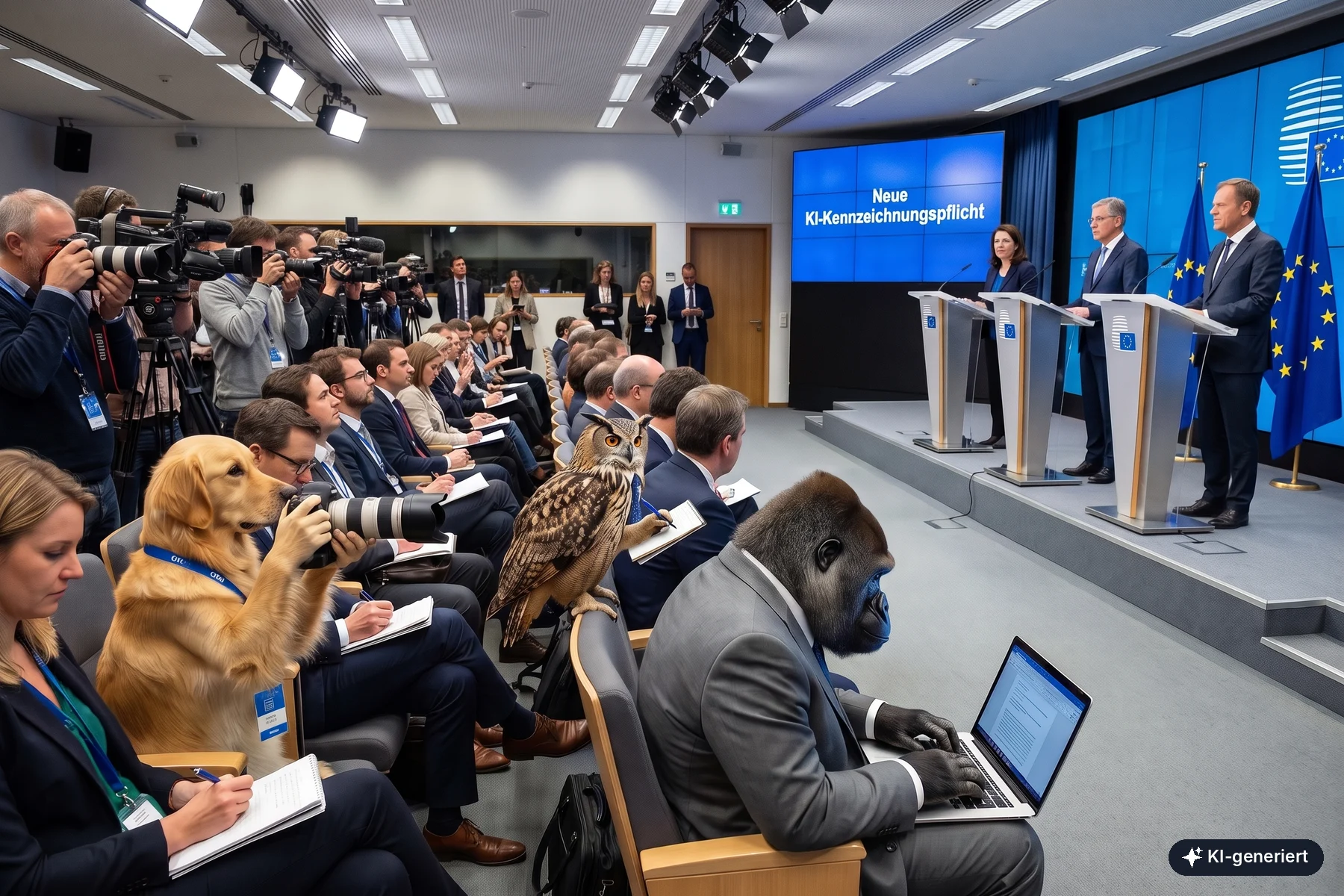
Who Are the People Behind Your Brand?
Together with you, we find the experts, customer champions and industry voices who make your solution credible, and we turn them into content that resonates with both people and AI agents.
I'll admit it: I have a trust problem. Not with people, but with answers. When an AI delivers a neatly worded assessment in seconds, I find myself asking more and more often: Who is actually behind this?
The question sounds trivial. It isn't. How we get our information is changing more fundamentally right now than at any point since the invention of the printing press. And that has direct consequences for how technology providers reach their customers.
The logic before AI was simple: a person creates content. So at best, we assume they've done their research and informed themselves sufficiently. Over centuries, this produced opinion-shaping texts that others picked up to confirm, criticize, or refute.
Libraries were the forerunners of the internet: places where people absorbed knowledge, discussed it, and developed it further. In Finland, by the way, they remain a central point of contact and a hub of social culture to this day – the Oodi Central Library in Helsinki is well worth a visit.

For the first time in history, a machine is now taking over a large share of this work. AI doesn't just gather information from sources around the world, it turns it directly into an opinion. Yet that was precisely what used to set humans apart from machines: having a stance of one's own that goes beyond zeros and ones.
What used to be called simply wrong is now called "hallucinating" and is often brushed off with a shrug: it happens. Fake news thus becomes legitimized maybe news.
The problem: our brains initially assume they're looking at the truth. And that they can trust it. Critical questioning has never been more important, yet in the flood of information it increasingly falls by the wayside.
So do we need more skeptics? People who don't just separate the wheat from the chaff, but hallucination from well-founded opinion?
So how do we form an opinion today? I see two pillars, which increasingly function separately from each other.
The first pillar is AI research. I send my AI off to gather information and find a solution to my problem. I assume the result is correct – and if I know the subject, I can check it with my own expertise.
But what if I lack exactly that expertise? What if I can't judge whether the proposed solution really solves my problem?
This is where the second pillar comes into play: verification by human experts. Suddenly, something we took for granted for a long time gains weight: trust in the judgment of a real person.
An art print is beautiful. But the hand-painted original is what's truly valuable. The value lies in what the machine can't (yet) do: create something new of its own accord. AI works retrospectively, based on the data it was trained on. At least for now.
Before we drift into a deep philosophical debate, let's get to the actual point: Do we marketers still have a role if AI can create all the content we publish through websites, whitepapers and webinars? My answer: Yes – if we remember what our job actually is.
For years, we were told we needed a content strategy and content that converts. That hasn't changed. Content is actually becoming more important, so that not only Google finds us, but above all AI agents (keywords: SEO and AIO). But why do we create all those headlines, taglines and whitepapers in the first place? To generate and build attention and trust with customers.
And this very trust is coming under pressure. According to the Expleo AI Pulse from August 2026, 36 percent of German executives would trust a company less if its communication were entirely AI-generated. Only 22 percent would trust it more.
AI search is also losing its shine: According to a study by Fractl and Search Engine Land, 82 percent of respondents found AI search more helpful than traditional search engines in 2025, but only 54 percent did in 2026. On average, they cross-check purchase decisions on 2.4 platforms.
So if you bludgeon your customers with obvious AI-generated text, you'll no longer be taken seriously. At the same time, content backed by real people with real expertise is becoming more valuable.
I consider three levers decisive:
That doesn't mean we should stop publishing AI-generated content. Agents need a lot of detailed information, and they are a firm part of the research process. But this content gains value when real people accompany, review and contextualize it.
„People learn from machines. Machines learn from people. But in B2B, people don't buy from machines.“

We are in a cycle in which key positions are now up for grabs. Whoever fills them will stay successful in go-to-market.
To make this work, vendors need three capabilities: creating content, verifying content, and humanizing content. By industry experts, I explicitly also mean the journalists at trade media.
The crucial point is stage 4: Anyone searching for solutions via AI today finds both the mass of vendor content and the experts' assessments, and can check one against the other. You are only visible if you are present on both levels.
One question keeps nagging me: What role do the big analyst firms play in this cycle? They would actually be predestined for stage 3, with their high credibility and deep market knowledge. But their cycles seem too slow to me for a market where solutions change on a weekly basis.
Something is shifting here right now: away from the annual report and toward faster, more personal assessments from individual analysts. I'm curious to hear how you see it.
AI will keep taking over research, and that's a good thing. But the more content machines generate, the more valuable it becomes when a human puts their name behind something. For tech marketing, that means: content volume for the agents, human credibility for the decision.
People buy from people. Even the best AI doesn't change that.
Together with you, we find the experts, customer champions and industry voices who make your solution credible, and we turn them into content that resonates with both people and AI agents.