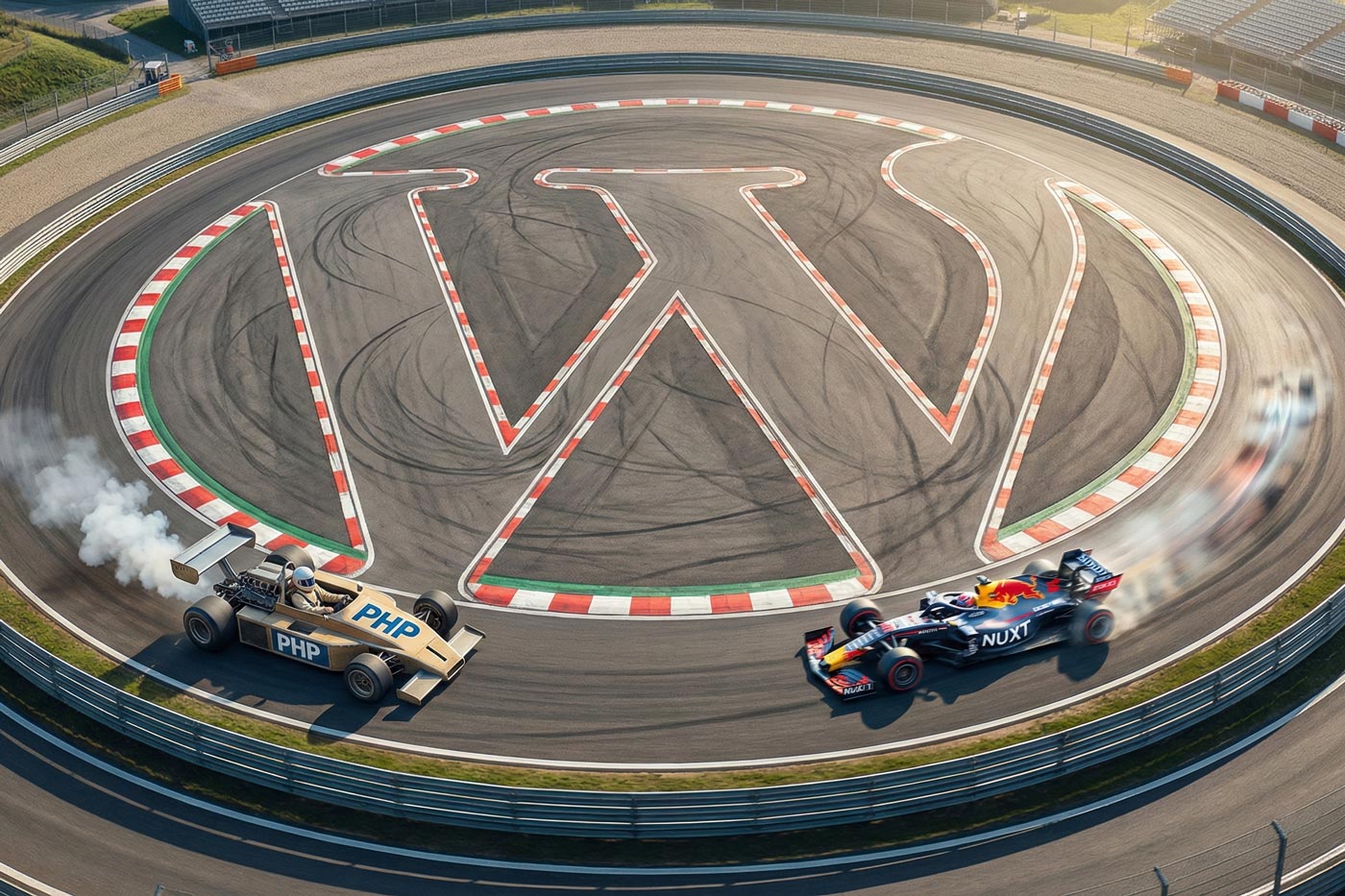
The End of Compromise: WordPress Comfort for Marketing, High-Performance for IT
The topic of Headless WordPress resolves a conflict that occurs in almost every company. Monday morning, Meeting Room 1:
The marketing team is frustrated: "We need more flexibility for landing pages. We want better SEO scores. And we want to keep our familiar WordPress editor."
The IT team rolls their eyes: "Please, not another plugin. The system is already unmanageable, slow, and a security risk. We want to use modern technologies, not yesterday's PHP."
For years, you had to choose: user-friendliness (WordPress) or modern performance architecture (React/Vue). But those days are over.
The solution to this conflict is called Headless WordPress.
In this article, we explain why decoupling the frontend and backend is the new standard for sophisticated corporate websites—and how you can make both camps happy.
Headless WordPress Explained: The End of the Monolith
To understand the solution, we must look at the problem. Classic WordPress is a "monolith". The backend (where you manage content) and the frontend (what the user sees) are inseparably fused. The theme controls everything. That was fine in 2015, but today it's often a hindrance.
With the headless approach, we "decapitate" WordPress. We separate the presentation layer from the system.
The Backend: WordPress remains, but serves only as a pure database and management interface.
The Connection: Through an interface (REST API or GraphQL), data flows outward.
The Frontend: A separate, state-of-the-art application (built with Next.js or Nuxt) retrieves this data and displays it to the user.
Victory for Marketing: Freedom & Performance
The biggest concern of content teams when switching technologies is often: "Do we have to learn a new, complicated CMS?" The answer with Headless WordPress is: No.
Familiar Environment: Your team continues to work in the familiar Gutenberg editor. Processes, workflows, and user rights remain exactly the same.
Core Web Vitals in the Green: Since the frontend is technologically decoupled from the heavy WordPress core, we can generate static pages (Static Site Generation). The result: The page loads not in 2 seconds, but in 200 milliseconds. Google loves that—and so does your conversion rate.
Omnichannel-Ready: The content from WordPress can be displayed not only on the website but simultaneously in an app, on smartwatches, or digital signage screens.
Victory for IT: Security & Scalability
For CTOs and developers, the headless approach is a liberation from legacy burdens.
Security through "Air Gap": The frontend is completely separated from the backend. If a hacker attacks your public website, they land in a static shell. They cannot access the WordPress database, as it can be on a protected server behind a firewall. The attack surface is drastically minimized.
No "Plugin Spaghetti": Design adjustments are cleanly programmed in modern JavaScript (React or Vue) instead of injecting risky third-party plugins into the WordPress core.
Endless Scalability: Since the frontend is often delivered via a Content Delivery Network (CDN), your site can withstand massive traffic spikes (e.g., after a TV spot) without the server buckling.
Nuxt or Next.js? The Strategic Choice of Frontend
Once the decision for headless is made, the next question arises: Which technology will handle the presentation? The two undisputed market leaders are Next.js (based on React) and Nuxt (based on Vue.js).
Both frameworks are excellent, offering Server-Side Rendering (SSR) and Static-Site Generation (SSG). The decision is therefore rarely a question of "better or worse", but of "fit with the team's DNA".
Next.js is developed by Vercel and is based on the Facebook library React.
The Advantage: It is the de facto standard in the enterprise environment. The ecosystem is huge, and since React is the world's most widespread JavaScript library, the talent pool of available developers is enormous.
Special Tip: For WordPress, there is Faust.js, a framework specifically built on Next.js that already includes many WordPress-specific functions (like previews and auth).
Ideal for: Large teams, complex applications, and companies that have already invested in the React ecosystem.
Nuxt is based on Vue.js and is known for its excellent "Developer Experience".
The Advantage: Nuxt follows the principle of "Convention over Configuration". It provides clear structures, reducing decisions within the team and often keeping the code cleaner. The syntax of Vue is closer to classic HTML/CSS, making it easier for designers and frontend developers to get started.
Performance: Nuxt applications are often extremely lightweight and performant by default.
Ideal for: Agencies, rapid prototyping, and teams that value clean, readable code and fast development cycles.
If you're unsure, ask yourself these three questions:
Recruiting: Do we find React or Vue developers more easily in our region (or remotely)? (Usually React/Next.js).
Team Structure: Do we have many classic web designers on the team? Then transitioning to Nuxt (Vue) is often more intuitive.
Ecosystem: Do we want to rely on specific WordPress headless tools like Faust.js? Then Next.js is the choice.
Our Recommendation:
Let the technology be decided not by hype, but by the expertise of your team or partner. We offer technology-neutral advice.
Conclusion: An Architecture for the Future
Headless WordPress is not a fleeting trend but the professionalization of the world's most popular CMS. It ends the trench warfare between marketing and IT by giving each team the tools they need: the best content for marketing and the best technology for IT.
If you're planning an enterprise website that needs to be secure, fast, and scalable, this architecture is hard to ignore.
Planning a website relaunch?
Let's figure out together whether Headless WordPress is the right fit for you – your marketing keeps the familiar Gutenberg editor, and your IT gets performance, security, and a clean architecture. In a first call we'll assess whether the switch pays off for your project.