Let's Talk About Social Media
Our social media experts are happy to advise you – from strategy through to implementation.

Ekaterina ZhurenkovaSocial Media
Cheerful energy is buzzing through the office: our LinkedIn engagement numbers have doubled over the past month! The social media manager is looking at the next report with a lot more confidence, management is already raising expectations as a precaution, and Sales is rubbing its hands at the thought of the inquiries that will soon start rolling in.
Scenes like this play out in many companies whenever social media performance suddenly jumps. By the same token, the mood turns gloomy when the numbers move in exactly the opposite direction. Yet in both cases, nobody has actually asked the most important question: did our post reach the people it was meant for?
Reach, engagement and the like are all wonderful metrics. They give us and others very precise insight into whether our efforts are currently paying off. But they aren't everything.
Anyone planning social media content therefore needs an idea of what the post is actually supposed to achieve, and that goes beyond the raw numbers. Otherwise, rising numbers can steer communication in a direction that has little to do with the original goal.
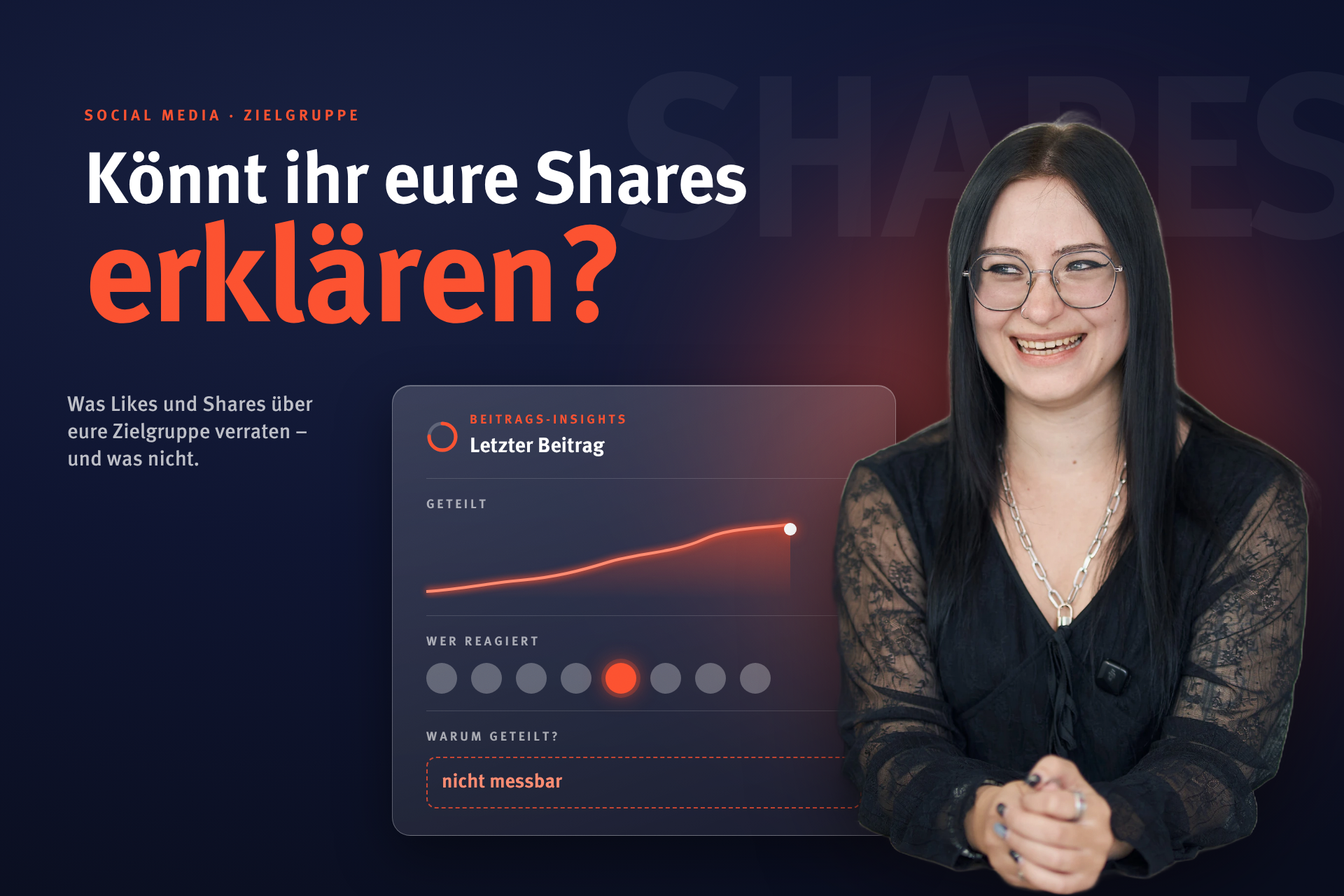
Let's take an example: a post is shared surprisingly often. From an engagement perspective, that's good news at first. But does this number really tell us anything on its own?
What the social media manager sees in the statistics at first is that the post is being shared a lot. A share initially shows nothing more than that something was passed on. The motive and the effect on the recipient can't be read from the number alone. Maybe it helps a colleague with an upcoming decision. Maybe it makes a friend laugh. It's just as possible that someone sends it along with a mocking comment.
A like also leaves questions open. Who reacted? Does this person belong to the desired target group? What appealed to them? When evaluating a post, it makes a difference whether a company wanted to share expertise, retain users or establish a first contact with its brand.
Reactions are therefore valuable observations. Their meaning, however, only emerges from the context in which they arise.
To understand this context, it helps to look at how content is delivered. Personalized feeds take into account how individual people use the platform in question. In its official explanation, TikTok, for example, cites user interactions, information about the content and information about the person. This also includes whether someone watches a video all the way through or skips it. For most users, TikTok weights interactions, including watch time, more heavily than other factors.[1]
The published repository for the "For You" feed on X offers a more detailed look. The model described there uses a person's recent interaction history to predict possible reactions to a post. The predictions are weighted and combined into a ranking score.[2]
When reading such weights, a calculation suggests itself: how many likes offset one negative reaction? The documentation explicitly warns against this conclusion. What gets weighted are predicted probabilities or predicted continuous values, such as dwell time. Reactions that have already been counted are not offset against each other at a fixed exchange rate.[2]
This makes an important distinction visible: the ranking score also depends on the person to whom a post might be shown. It can't be read as a general seal of quality for that post.
These examples describe specific systems. They don't provide a universal formula for all platforms. For communication planning, however, they show why the question of relevant content can only be answered by looking at the people being addressed.
For companies, this quickly becomes a strategic risk. What looks good in reporting easily becomes the template for the next post. A successful format gets repeated, and an attention-grabbing angle gets sharpened even further. That's understandable at first: teams have to decide where to spend their limited production time.
It becomes problematic when the measured response increasingly determines what the team considers success. Then a post that gets many people to comment can win, even though it barely answers the professional question of the intended target group. A helpful post on a narrower topic can lose in a direct comparison of numbers.
This isn't an inevitable development. Entertainment can suit a brand, discussion can be a communication goal, and broad reach can build awareness. But the most important thing is that a team can explain what contribution these results make to its own goal.
Because companies can align their content ever more successfully with platform reactions and, in doing so, drift away from the needs of their actual target group.
Anyone who wants to consistently avoid this therefore has to clarify, already at the topic selection stage, whose attention a post should earn and for what purpose.
Even though it's part of Social Media 101, we can't stress it enough: a clear target group definition such as "marketing managers in mid-sized companies" helps with orientation. For an individual post, though, it often remains abstract, since even within groups there are people with very different questions.
This is where the experience perspective comes in: What does a person experience when they come across the post? Do they recognize why it's relevant to them? Can they understand the message and use it for their own concern?
This broadens the task of content production. An attention-grabbing opening has to fit the content that follows. A diagram has to be legible on a smartphone. A link should make clear what lies behind it. If someone finds something different after the click than they expected, they may have been prompted to take a measurable action. Yet their actual need for information remains unmet.
A post and its next touchpoint therefore have to be planned together.
The consequence can be translated into four questions. They help turn a topic idea into a content decision that fits the target audience.
Who is the post intended for in this situation?
What specific question is on this person's mind right now? The answer should go beyond job title and demographic characteristics.
What behavior would make sense for our communication goal?
Should someone watch an explanation to the end, save a work aid, or open an in-depth article? Not every post needs an immediate click. Understanding a professional position can also be the intended effect.
Why should the person do that?
What benefit do they get from it? A prompt to save or share does not replace that benefit.
What might stop them?
Is the opening unclear, the graphic too small, or the next step too time-consuming? This is where content and design are reviewed together.
These questions make it clear why a post is designed exactly the way it is and not differently. And above all, which observations will be relevant for its evaluation later.
With this clarity, reporting also changes – ideally. Engagement figures, reach, etc. will of course remain an important part of performance review in the future. However, it should always be supplemented by the question of whether the intended effect on the desired target audience can be plausibly identified.
The content of comments and follow-up questions can be helpful for this, for example. With a linked article, you can examine how visitors use it and whether they take the intended next step. Depending on the platform, available audience information provides additional clues. None of these signals alone proves that a communication goal has been achieved.
For companies, this means aligning their evaluation with the task at hand and combining several observations. A single post will rarely be able to explain whether brand trust has grown among readers or whether some purchasing decision has been influenced. Such effects require a longer observation period and additional feedback.
Reaching your own target audience on social media therefore begins before publication: with a concrete idea of whom a post is meant to help, and in which situation. This idea gives production a direction and gives performance measurement a benchmark. It also determines which content a team repeats next time.
[1] TikTok Support: How TikTok Recommends Content.
[2] X / xAI: X For You Feed Algorithm
Our social media experts are happy to advise you – from strategy through to implementation.