
Public Relations Has Nothing to Do with Advertising
There is certainly no shortage of definitions for the ideal distinctions between PR and marketing, but: The boundaries between subtle advertising and serious public relations are increasingly blurring in the fast-paced realm of the World Wide Web. However, those who understand the meaning, function, goals, and tasks of Public Relations will recognize clear differences. The factor of "time" plays a significant role here.
Even though the discipline has existed for hundreds of years, the same mistakes are repeatedly made: The advertising hammer is brought out far too often. But why do companies frequently struggle to objectively engage with themselves? By definition, everything should be so simple:
"Public Relations (PR) is the systematic and long-term management of a company's communication with important reference groups from society. The goal is to stay in contact with these reference groups and to shape the strong and unique image of the company's personality." This is the modern definition by Prof. Dr. Dieter Georg Herbst, as taught at every university.
In 1937, Carl Hundhausen provided the following definition in his article in the magazine Die deutsche Werbung: "Public Relations is the art of creating a favorable public opinion for one's own company, its product, or service through spoken or printed words, actions, or visible symbols."
Together, both definitions capture the essence of PR very accurately. Generally, the aim is to engage with reference groups and influence public opinion. The term "Öffentlichkeitsarbeit" (public relations) is more comprehensible in the English original "Public Relations," as it addresses not only the work with the public but also emphasizes the relationships between the public and the company.

Whether green, yellow, red, or blue, it doesn't matter – A company's image determines whether partners and clients associate positive or negative thoughts with it. Source: pexels.com
Reference Groups
However, based on common definitions, it is not clearly evident how PR differs from advertising and marketing. Isn't every external corporate communication always a bit of advertising? This question needs to be considered in a differentiated manner, as the mechanisms of classic PR are indeed different.
Every company inevitably needs reference groups (whether B2B or B2C is beside the point) – that is, people on whom the company depends to achieve its goals. The first reference group is already within the company itself: executives, employees, trainees, works councils, etc., carry a certain image of their company, which can only be changed through "communication." Communication becomes crucial for the success of a business when companies want to address the market: customers, shareholders, dealers, suppliers, business partners, etc., will be interested in the company's self-presentation before they might consider a "joint venture" (of any kind). The reference groups in society – journalists, residents, clubs, initiatives, associations, scientists, authorities, politicians, etc. – ultimately represent the "more critical" recipients of PR. What content, what tone, and how much tact are required depend primarily on the respective reference group being addressed.
The goal of PR remains the same: to win people over, support their concerns, and build long-term relationships with them. The basis of professional PR is therefore based on the credo: the more well-known a company is, the more likable it is considered. This is called the Mere-Exposure Effect.
Image
The central questions for the in-house PR strategy are therefore: What does the company stand for? What does the company uniquely offer to the reference groups? However, even if facts and information form the basis of the company's opinion formation, it is ultimately the image – the mental picture formed and evaluated in the minds of the respective reference groups – that decides on positive or negative behavior towards the company.
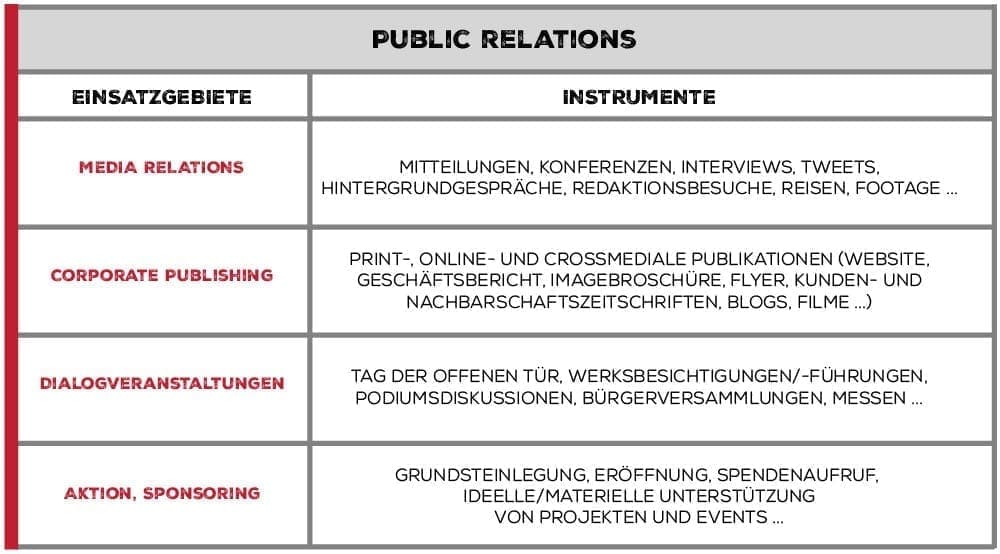
When companies try to build a positive, strong image, they usually proceed as follows: First, they regularly – but not intrusively – convey their stable, slowly evolving, central features to selected communication partners. It is important to always project a consistent, coherent appearance externally. Highlighting the USP – a clear profile and market differentiation – and long-term, sustainable relationship management build trust in the brand and are the most reliable basis for long-term relationships. There are many areas of application and instruments (see graphic).
Distinction from Advertising and Marketing
Especially in the last paragraph, it becomes most evident how advertising and public relations differ centrally: Marketing and advertising are always thought of in the short term – until the next new service or the next better product is launched, rendering what has been said obsolete. PR, on the other hand, is thought of in the long term and relies on fundamental messages that endure for years or even decades.

Advertising and marketing are characterized by their fast pace: What is considered chic and trendy today may be "out" tomorrow. PR is different: The company as a brand should still shine the day after tomorrow. Source: pexels.com
Thus, marketing and advertising primarily refer to profit-oriented organizations (companies) and market-relevant processes. The focus is on consumers as the main target group. In contrast, the PR concept applies to all forms of organizations, including NPOs, NGOs, or parties, focusing on all stakeholders and not just consumers or customers.
PR Has Many Faces
Public relations and advertising communication also differ in terms of their intended goals, the feedback of communication, the intended target groups, and their different argumentation. Advertising is understood as the transmission of information through the use of paid media with clear identification of the communication source. In contrast, PR primarily aims to gain understanding and trust through influencing opinion formation, thereby strengthening the image of the respective organization. Important disciplines of PR are therefore also media work, corporate publishing, and increasingly live events such as trade fairs.
The objectives of PR have not changed over the centuries. One of the first precursors of public relations was initiated in 1622 by Pope Gregory XV – through the establishment of the "Congregation for the Evangelization of Peoples," which aimed to counteract the Catholic Church's loss of influence due to the spreading Protestantism. Thus, for Pope Gregory and his successors, it was about gaining understanding and trust for their – sometimes very cruel – religious policies through influencing opinion formation.
Well, PR indeed has many faces.