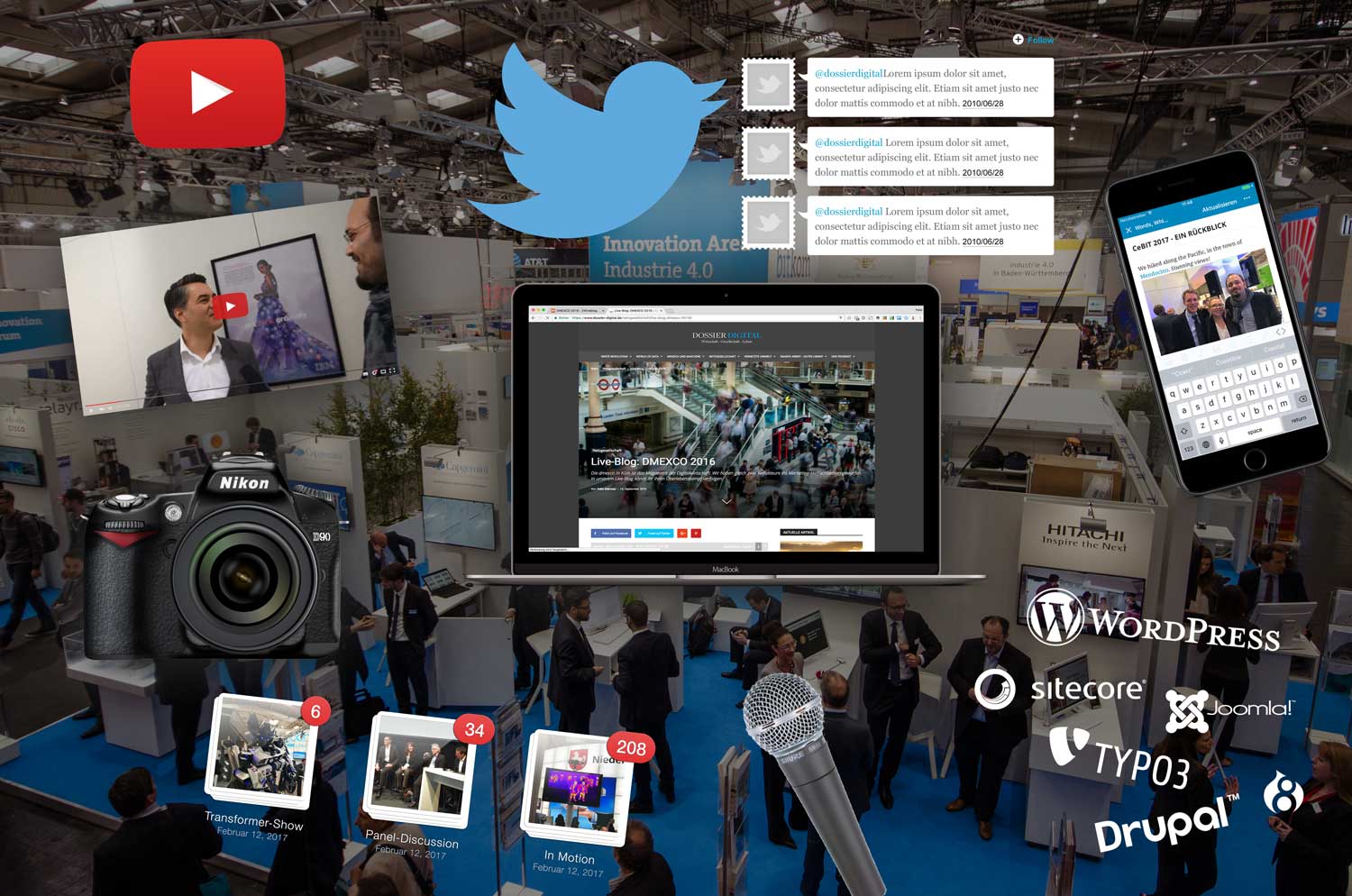
Live Blogging of Events
Anyone attending a conference, trade show, or event, or even organizing one, should consider using a live blog as a medium because: If you approach the tightly scheduled production and publication of information, images, and videos simultaneously with the ongoing event correctly, you can significantly increase the reach of your core message online. Unlike covering an event solely on social media, a live blog stands out due to its thematic focus, editorial preparation, and the place of publication — namely, on your own website.
Comprehensive coverage of conferences, trade shows, or business events often leads to reader resignation. The reason? There is a lack of focus on a sharp theme that genuinely interests the consumer and, thanks to its pointedness, creates real added value — following the motto: "If you try to report on everything, you end up reporting on nothing."
In live blogging, which involves step-by-step reporting in easily consumable bites — ideally consisting of a mix of text, video, and images — directly and "live" from an event, the goal is not to report on everything and everyone. On the contrary: When companies inform about an event in their industry via a live blog, they create a snapshot of an event on a very specific topic — embedded in an editorial context.
Specifically, this means: Focusing on a core theme — which, of course, is clearly or at least remotely related to the company's own products and services — should attract as many visitors as possible to the company's website where the live blog is hosted on the day of the event.
Here is a collection of experiences and tips for your next live blog, clearly showing: The effort is manageable, but the result often generates significant attention.
Essential for Every Live Blog: The Right Topic Setting
Before the event day can truly begin, a rough topic setting should first be established in preparation for the live blog, under which the event or conference will be reported. The range of available topics is often too broad and the team too small to comprehensively report live from a trade show, for example. It is often advisable to select a very specific topic area and then work it out thoroughly and in-depth. The event agenda or trade show plan often serves as a helpful guide to analyze trend topics — also via Twitter and other industry media — at least to some extent in advance.


Good Preparation is Half the Battle
On the day of the event, good preparation is often essential for quick orientation. You should be able to answer the following questions:
- In which halls/locations are the trend topics relevant to me located?
- Do I know exactly which person is speaking when and where on which stage/location?
- Have I planned enough time to get from A to B?
- Where can I retreat to a quieter environment to process the generated content with a laptop and camera and possibly edit videos/photos?
- Have I planned time to catch my breath, and where can I possibly pre-produce content? Because: The constant pressure to publish is challenging and exhausting in the long run.
Good Equipment Enhances the Quality of Your Live Blog
To successfully run such a live blog, the following selected equipment is, in our view, the absolute minimum and should be extensively tested and practiced in combination by the live blogger beforehand.

A modern smartphone for photos and short videos for direct publication

A DSLR camera (e.g., Nikon D5300) with film function for good and sharp videos

An interview microphone for high-quality audio recordings of interviews (e.g., Rode NTG3)

A tripod for stable video/photo recordings

A powerful laptop: Essential for film production live on-site (e.g., HP Pro Book or Apple MacBook Pro)

A powerful video editing software (e.g., Adobe Premiere, Final Cut Pro X), in which you are already practiced and have templates prepared for content creation.

Reliable mobile internet with a large data package — while Wi-Fi is available almost everywhere today, reliability is often moderate, especially at large events.

A power bank, because the battery of devices drains faster in such situations than you might think.
An Editorial Tool for Distributing Your Content
For distribution, editing, and integration of the produced content into your respective CMS system, one of the two tools is an absolute must-have. Both software applications are "relatively" easy to use for beginners and also provide all necessary editing functions for more advanced bloggers.

Scribble Live

24LiveBlog
Time Planning Supports the Workflow in Reporting
Before the live blog, the following should be established:
- Planning the publication schedule in a fixed rhythm? Every half hour? Every 10 minutes? Hourly?
- Subsequently preparing a rough editorial plan with pre-selected topics — contacts — panels — images — videos, etc.


Clear Distribution of Tasks in the Team
While one live blogger searches for topics, contacts, and potential sound bites as well as images, the other operates in the background and can process and prepare the generated content. The workload involved in, for example, live video editing, text editing, and rendering on-site should not be underestimated. An interview with video — from our experience — really only works well with two people: One asks the questions, conducts the conversation, and holds the microphone, while the other films.
Examples of Live Blogs
Finally — and for further exploration — here are two references of live blogs that our teams have successfully supported.

Live Blog – "Content Everywhere" from DMEXCO 2016.