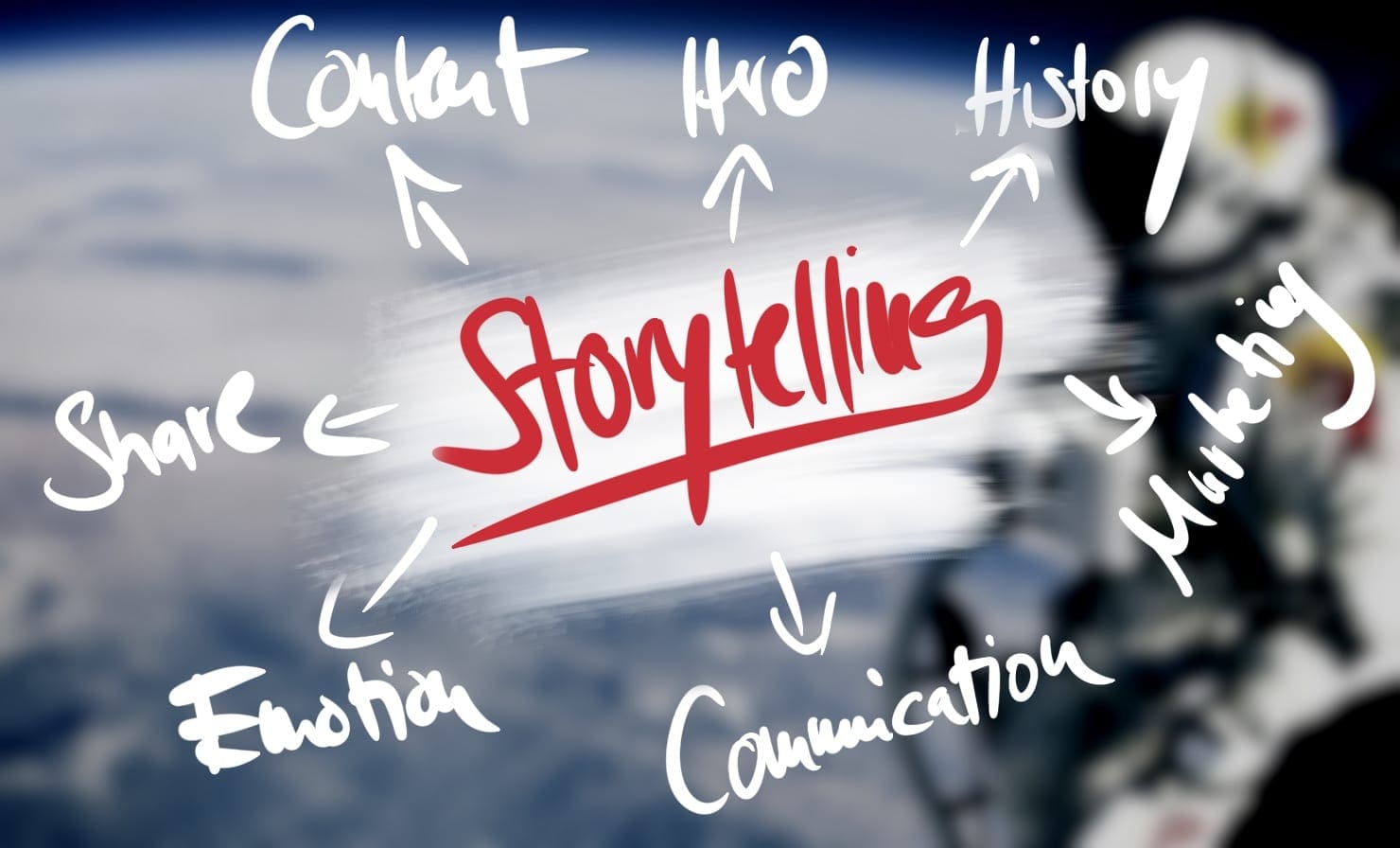
Corporate Storytelling – Why It Is Important for Companies to Tell Their Own Stories
Everyone loves a good, gripping story. And we are convinced: every company has a story worth telling. With good storytelling, customers can be much more intensely connected to the brand than simple advertising ever could. In this blog post, we explain how to reach the right people with a good story.
Stories are as old as humanity. As far back as 200,000 years ago, our ancestors shared legends, myths, and anecdotes around the campfire—for entertainment, amusement, but above all as a teaching tool. The importance of stories for our development can also be proven neurologically: the human brain can retain information much better when it is conveyed in the form of narratives. This is also why we still use mnemonic devices today to help us remember important information more easily.
Moreover, captivating stories evoke emotions and release oxytocin—the so-called "bonding hormone", which strengthens our trust and promotes social bonds and empathy. Conveying messages memorably while also evoking strong emotions is an absolute dream for marketing specialists.
According to a study by Stanford University, storytelling in content marketing can achieve up to five times higher sales success. It is therefore entirely clear that storytelling must be a fundamental component of good corporate communication today.
What is Corporate Storytelling?
Corporate storytelling tells the small and large stories. The essence, personality, and actions of a company are woven into a narrative context, conveying the vision, goals, and values with which the company identifies both internally and externally.
Corporate storytelling goes further than some advertising texts. The small text blocks in the "About Us" section of the company's website are forgotten by the reader as soon as they close their browser. Stories, on the other hand, that emotionally stage, metaphorically illustrate, and make company values and goals tangible, stay in the mind. So what does a story need to evoke emotions and embed itself in the listeners' memory?

Corporate storytelling always tries to simplify information and present it vividly.
How does Corporate Storytelling work?
There are various approaches to defining the different components of stories. What they all have in common is that a story should convey a message. The plot describes a conflict that is resolved by a hero. What sounds like the staging of a fairy tale can essentially be applied to stories in the corporate environment.
An example: On October 14, 2012, Austrian extreme athlete Felix Baumgartner broke several world records when he jumped from the stratosphere in a pressure suit with a parachute. From 38,969 meters, he plummeted towards Earth in free fall, reaching supersonic speed. At 12
p.m., nine minutes after jumping, he finally had solid ground under his feet again. He made it. And along the way, he collected important technical and medical data that are invaluable for space travel.The action was sponsored by Red Bull. The "Stratos" project generated massive media coverage: around eight million viewers watched the live event on YouTube—another 2.3 million followed the jump on ORF. Red Bull managed to tell such a gripping story that people all over the world talked about it and were on the edge of their seats.
But what was the message behind it? Quite simply: "Red Bull gives you wings". The beverage manufacturer cleverly embeds the story into its marketing strategy and reinforces the image of the unconventional, rebellious high-flyer. But what is the conflict in the "Stratos" project?
In this case, it is the conflict of Felix Baumgartner, the hero of the story:

The protagonist in storytelling is always the hero who must solve a conflict to reach the goal.
Does he have the courage to jump from almost 40 kilometers high? And will he survive the daring jump? You are on the edge of your seat, afraid—and hoping that everything goes well.
Of course, it wasn't the energy drink itself that dominated the story. Nor did the company provide the main identification surface onto which viewers could project their hopes and fears. This is usually, and so it was here, reserved for the hero of the story. However, Red Bull succeeded in inseparably linking itself and its message with the daring venture.
By the way, Red Bull spent 50 million euros on the whole thing. It was certainly not a loss-making deal—on the contrary: According to a report by Meedia, the company achieved a marketing effect in the "multi-million range".
Conclusion
Stories generally follow the same pattern. They aim to reduce complexity, facilitate understanding, and offer added value to listeners. They are experiential, comprehensible, and create a sense of belonging. The continuity of the brand message is particularly important here.
In corporate storytelling, the goal is to evoke emotions to convey the message as compellingly as possible and to sustainably bind customers to the brand. The rule is: well told is well sold. Memorable images underpin the company's message and create authenticity. This, in turn, strengthens customer trust and embeds itself in their minds.