
Brand Personality & Tone: How to Find the Right Voice for Your Business
Apple, Google, Lego – all companies with a distinctive brand presence. What they share: consistency and a coherent language. But how do companies find the right tone for their brand? That's what we're discussing in this blog.
Strong brands clearly have the upper hand with consumers: More than 50 million Germans respond to the question of whether they remain loyal to a brand when satisfied with "Somewhat agree" or "Agree". Brands offer a crucial unique selling point in a competitive market, ensuring that companies stand out from the crowd of competitors.
Essential to fully leverage a brand's potential: coherent brand management. The user experience with a brand should feel as consistent as possible at every touchpoint – a visit to the website will contribute to the evaluation just as much as personal consultation in the store.
But first, companies need to understand the brand and determine how it communicates with its customers. The brand personality is what gives a brand humanity and makes it approachable in the eyes of customers. It is conveyed through visual and verbal means. While we explore the visual expressions of the brand in another article, in this article we take a look at the tone. It reflects HOW, i.e., in what tone, with what vocabulary, and with what underlying mood the content is conveyed.
Defining the Brand
Using frameworks that aid in the development of brand personality, companies can make the brand tangible for themselves – and consequently later for stakeholders. Brands can be described, for example, using Jennifer Aaker's character dimensions model or Carl Gustav Jung's archetypes of the human psyche.
The Model by Jennifer Aaker
According to this model, the personality of brands can be divided into five core dimensions: Sincerity, Excitement, Competence, Sophistication, and Ruggedness. All adjectives suitable for describing a brand can be assigned to one of these five core dimensions. By collecting all the adjectives that they want to define their brand with and assigning them to the respective core dimensions, companies already get an impression of the brand's characteristics.
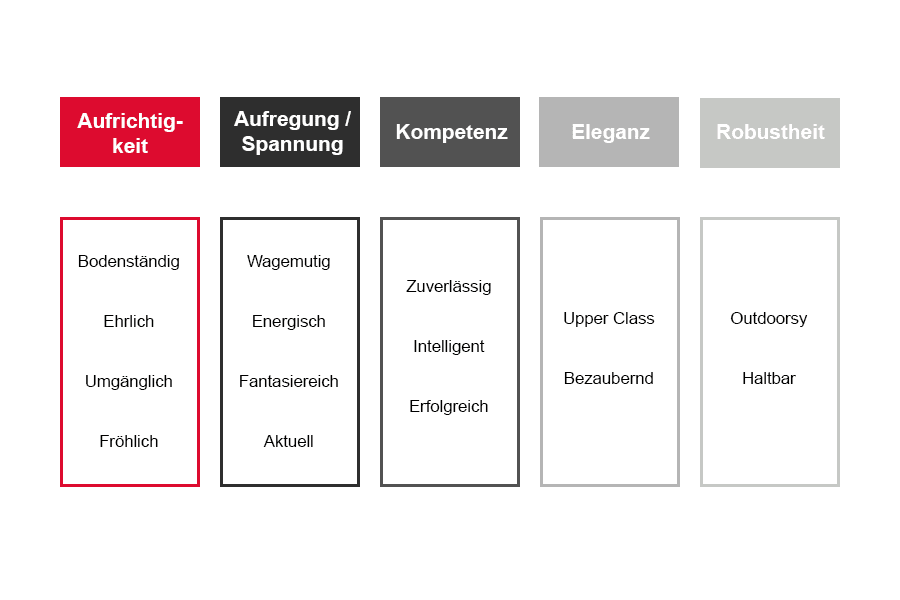
Small tip: Don't randomly collect appealing adjectives, but focus on a few key attributes. This brings consistency to the brand image from the start.
Archetypes by Carl Gustav Jung
The psychiatrist Carl Gustav Jung is considered the "founder of analytical psychology". He believed that people use various symbols to understand abstract concepts. He developed twelve archetypes that represent subconscious basic structures of our psyche and are supposed to significantly determine our patterns of thought and action. These archetypes can also be used to describe a brand.
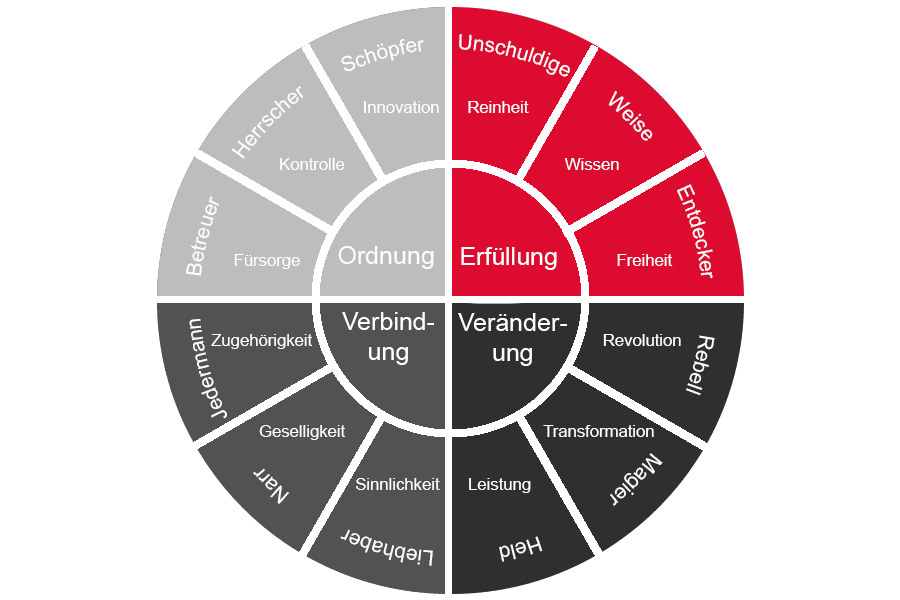
The Brand as a Person
In the final step, the brand's core dimensions and archetype are combined. The result: a tangible image. First, imagine the brand as a person to then answer the following questions:
How old is the person?
What gender is the person?
Where does the person come from / what ethnicity do they belong to?
Where do they live?
What is their living situation? (Apartment in the city, house in the countryside?)
What is their relationship status? Do they have children?
What hobbies do they have?
What profession do they practice – in what position?
Which political party do they vote for?
This is just a selection of possible questions that can comprehensively describe a brand in its personified version. At first glance, some of the questions may seem a bit odd – however, they all contribute to understanding the (intended) impact more precisely. Social status or profession, for example, help assess the brand's performance and competence, while questions about political stance and personality provide insights into the brand's emotional values.
How Does the Brand Speak?
Based on this information, companies can already form a good picture of how their brand communicates. An emotional brand, for example, will avoid overly technical language, while a brand focused on competence and expertise will typically opt for precise and knowledgeable expression.
The next step is to establish the basic rules of communication so that all brand representatives can speak with one voice. A communication guideline is often used for this purpose. Similar to a CI style guide, it comprehensively records what constitutes a company's tone. Everyone in the company who represents the brand externally should be able to adapt their communication to the brand personality. The basic rule is: there are no unspoken rules. If a particular aspect is important for the tone, it is recorded here.
What a communication guideline should include:
Perspective & Address
How does the brand refer to itself and how does it address its audiences? Brands can speak from the "I" perspective or from "We". While the "I" perspective is less common in corporate communication, "We" is particularly favored by brands that communicate on an emotional and personal level. The indirect perspective in the 3rd person singular is also not uncommon and has its own effect: it creates a professional distance and establishes the brand more as a separate entity. In this case, target groups tend to associate the brand less with concrete individuals and more with abstract values.
Also falling into this category is the manner in which the brand addresses its target groups. First, a distinction is made between indirect and direct address. In indirect address, there is often talk of "our customers" or "long-term partners". The target group is not addressed on a personal level – this is less intrusive but can also create too much distance. If the brand addresses the target group directly, further questions arise that need to be clarified: informal or formal address? Or is it better to avoid formalities and opt for the inviting and personal "you"?
Expression
The expression – whether a brand uses jargon or colloquial language – must also be clearly defined. High-quality or competence-focused brands prefer to steer clear of slang. For emotional brands, the use of colloquial language may be appropriate – as long as it is used thoughtfully.
Language Tempo
Less common but no less important is the tempo of the language. This refers less to the speaking speed of employees and more to the length and conciseness of sentences. Short sentences speed up reading. Longer sentences, which may include subordinate clauses, slow down the reading flow and can guide the reader more consciously through text passages. Even if no brand can focus exclusively on short or long sentences, the dominant language tempo determines how the brand is perceived overall.
Dos & Don’ts
A comprehensive communication guide also includes which expressions are preferred and which are not acceptable. A Dos & Don’ts list is useful for this, where desired examples can be clearly contrasted with the undesirable ones.
The top priority in the communication guide is: provide examples and be specific. This makes it easier for employees to communicate with target groups in the spirit of the brand.
Conclusion
For a brand to present a strong and unified image externally, it must communicate consistently and with one voice. The prerequisite for a unique appearance – both visually and verbally – is understanding the brand's personality. Once companies know the brand personality and have defined how the brand speaks, they should also take the opportunity to look at the Corporate Identity. How this can be achieved will be revealed in part 2 of the series.